
Pretty Links can automatically anonymize visitor IP addresses before they’re written to your database, helping you stay compliant with privacy regulations like GDPR (Europe) and CCPA (California).
Find this setting at Dashboard > Pretty Links > Options > Reporting.
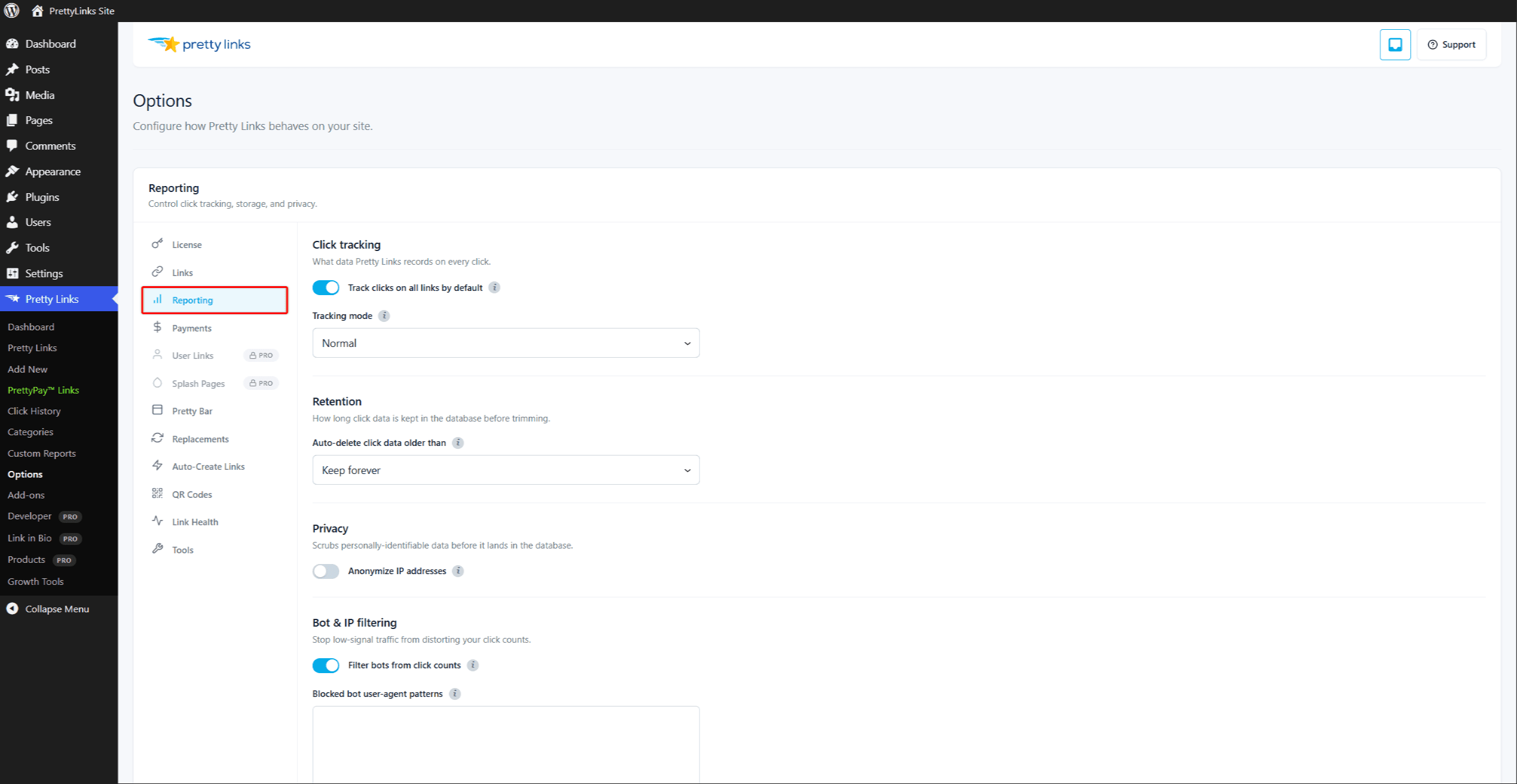
What Anonymization Does
When IP anonymization is enabled, Pretty Links zeroes out the last portion of every visitor’s IP before storing it.
- IPv4 addresses have their last octet zeroed, keeping the first three octets (a /24 mask). So
203.0.113.42becomes203.0.113.0. - IPv6 addresses have their last 80 bits zeroed, keeping the first 48 bits (a /48 mask). So
2001:db8:1234:5678:abcd:ef01:2345:6789becomes roughly2001:db8:1234:0:0:0:0:0.
Once stored, the original full IP is gone — Pretty Links never had a record of it past the moment of anonymization.
Why It Matters
Under GDPR, IP addresses are considered personal data. Storing them without consent or a clear legal basis can expose you to compliance risk. CCPA has similar implications for California residents.
Anonymized IPs are generally considered non-personal data because they no longer identify a specific household — they identify a neighborhood at most. That makes them much safer to store and analyze.
If your visitors are in regulated jurisdictions and you don’t have a strong reason to keep full IPs, turn anonymization on.
Trade-Offs
Anonymization preserves most of what makes IP tracking useful, but you do lose some precision:
- Country detection — Still accurate. The first three octets of an IPv4 address reliably identify the country;
- Region detection — Mostly accurate. Region (state/province) is usually preserved;
- City detection — Less reliable. Cities often share IP ranges that span multiple municipalities, and zeroing the last octet can blur boundaries;
- Per-visitor identification by IP — Largely lost. Many real visitors will share the same anonymized IP. (Pretty Links uses a separate cookie for unique visitor tracking, so this isn’t usually a problem — see Cookies Explained.);
- Per-IP filtering — Still works, but each anonymized IP now represents up to 256 real users, so blocking one anonymized IP is a heavier hammer than blocking one full IP.
For most sites, the trade-off is worth it: you keep useful country and region data, you keep unique-visitor counts via cookies, and you significantly reduce your privacy exposure.
When to Leave Anonymization Off
Some sites have a legitimate reason to store full IPs — for example, fraud detection, abuse monitoring, or security investigations. If you have a documented legal basis (such as legitimate interest under GDPR) and a published privacy policy, you may choose to leave anonymization off.
If you’re not sure, anonymize. It’s the safer default, and the cost in lost detail is small.
Anonymization Happens Before Storage
Pretty Links anonymizes IPs before writing them to your database — not afterward. That means even if someone gains access to your raw database, they won’t find unanonymized IPs there.
Combining With Other Privacy Features
For a fuller privacy posture, combine IP anonymization with:
- Simple tracking mode — Stores only counts, no per-click data at all. See Click Tracking Modes;
- Cookie controls — See Cookies Explained for what Pretty Links sets and why;
- A clear privacy policy — Tell your visitors what you collect and why.