

Contents
You can promote the same product, use the same affiliate link, and send people to the same offer, but get completely different results depending on where that link appears.
Most affiliate marketers notice the low clicks first. They share a recommendation, wait for people to act, and when only a few do, they start questioning the offer, the copy, or the commission rate.
Sometimes those things matter. But often, the bigger issue is placement.
A link dropped in front of an audience behaves differently from a link shared inside a community. One is broadcast to people who may or may not be ready. The other shows up in a space where questions, trust, shared experiences, and peer recommendations already exist.
Inside a community, a recommendation shows up with trust, context, and timing already attached – three things a link broadcast to an audience has to earn from scratch.
In this article, we’ll break down 5 specific reasons the same affiliate link converts better inside a community than in front of an audience.
5 Reasons Affiliate Links Convert Better Inside a Community
The same link does more work in a community because the community has already done some of that work for you – sorting who’s paying attention, building the trust, setting up the moment.
Stack those up, and you get a conversion rate a general audience can’t match.
1. Your Links Live Inside the Content Your Community Already Showed Up For
A community forms around what you publish. People don’t land there by accident – they found your content, decided they wanted more of it, and joined to get closer to the source.
The content is the entire reason the community exists, which means anything you put inside it reaches people who have already chosen to be in the room.
That choice is what separates a community member from a follower. A follower might like one post and never think about you again. Someone a search engine drops onto your page, reads one article, and bounces.
A community member signed up – and when the community runs on a membership platform, they’re often paying for access.
MemberPress is where that community lives: it runs the sign-ups, the paid tiers, and the gated content that turn casual readers into members who show up on purpose.
All of that adds up to intent. A community member is already interested in your topic, which puts them somewhere in your funnel before you recommend anything – and intent is what moves conversion.
In recent benchmark data, referral traffic (people arriving through a source they already trust) converts about 3x higher than a broadcast social audience – roughly 2.9% versus 0.9%.
A community member sits at the high-intent end of that range: they’re not deciding whether they care about the topic; they’re deciding what to buy for it.
So whatever affiliate link lives in that content reaches someone already leaning toward the purchase before you make it. Martal Group
💡 Build it on MemberPress: Set up paid membership tiers and gate your best content so people have a reason to join instead of passively following. [Get Started with MemberPress]
2. Community Members Trust Recommendations from Each Other, Not Just from You
In a community, trust isn’t something you generate single-handedly – it builds in the conversation. Members answer each other’s questions, post their results, and name the tools they actually use, day after day.
That back-and-forth is what turns a group of strangers into people who take each other’s word seriously. The talking is doing the work.
An audience works differently. When you broadcast a recommendation to followers, the trust rests entirely on you. There’s no conversation underneath it and no other voice backing it up – the follower either believes you or they don’t, and that’s the whole transaction. You’re the only thing standing behind the link.
Inside a community, your recommendation stops carrying that weight alone. The moment you share a link, it lands in a space where people already vouch for each other, so part of the credibility is built in before you say a word.
A recommendation that would otherwise live or die on your reputation now has a room full of people who trust each other standing behind it.
Once that trust is in place, something better starts happening: members promote for you. You can still drop a link yourself, but when a community is really working, a member answers someone’s question with one of your links before you ever get there – sometimes the exact article link that convinced them to buy in the first place.
Someone asks, “What does everyone use for X?” and your affiliate link is the answer, whether you post it or another member posts it for you.
A recommendation that lands in a room that already trusts you – or that comes from a fellow member – converts faster than one starting from zero every time.
Buyers want corroboration before they act: 97% of consumers still lean on reviews and peer input to guide their purchase decisions, per BrightLocal’s 2026 review survey. A community supplies that corroboration in real time, attached to your link, right when someone’s deciding.
3. When One Member Buys, the Rest of the Community Follows
Purchases inside a community don’t happen quietly. Members watch each other buy, ask each other about it, and post their results out in the open where everyone scrolling the thread can read them.
That visibility is the part an audience can’t reproduce – when you sell to followers, every purchase happens in private, one person at a time, with no one else around to see it land.
The proof also hits harder because of who it comes from. A result from another member – someone in the same niche, chasing the same goal, dealing with the same problem – carries weight your recommendation never could on its own.
There’s a real gap between the host saying “this works” and a person just like the reader saying “this worked for me.” That second version is what moves the fence-sitters who were never going to act on your word alone.
It also means objections get cleared without you in the room. When a member hesitates – is it actually worth it, does it really do what it claims – the people who already bought step in and answer. The doubt gets handled in public, by someone with no reason to oversell it, before it ever costs you the sale.
That settles into a pattern you’ll start to recognize. A member posts their result. Others reply asking how they did it and where they got it. And the link you shared days or weeks earlier gets clicked all over again – not because you pushed it, but because they trust that member’s result more than any pitch:
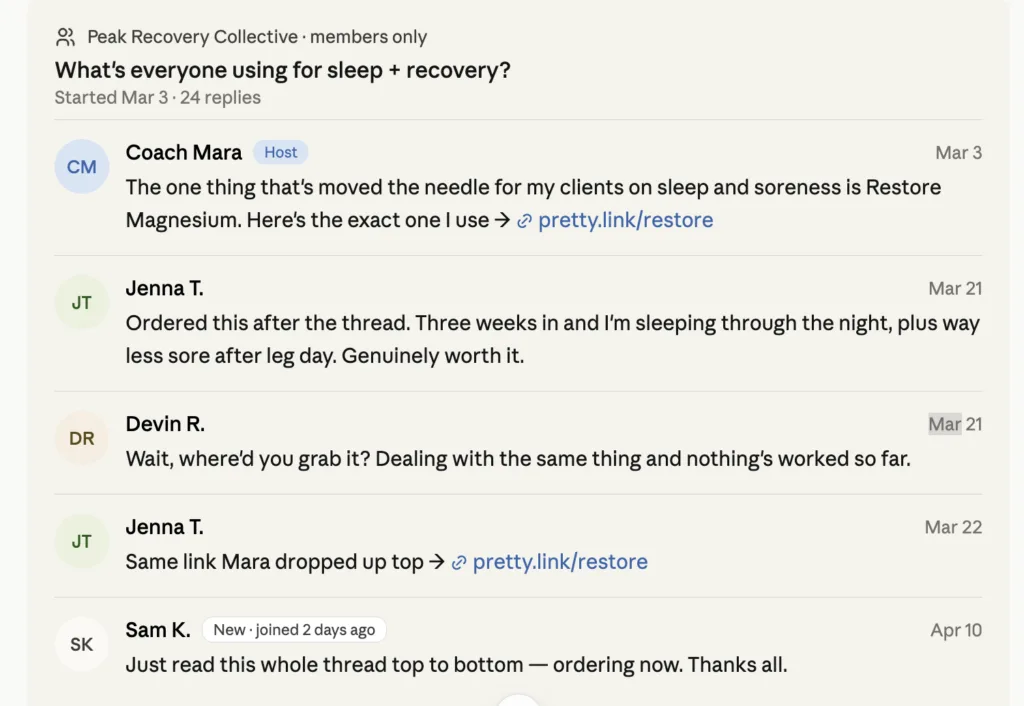
Look at the dates. The recommendation went up March 3, the result landed March 21, and a brand-new member ordered off the same thread on April 10 – proof that what happens after you’ve moved on is where this compounds. The thread stays up.
Someone who joins weeks later scrolls back, reads that same purchase and that same result, and clicks through without you posting anything new. One recommendation you made once keeps converting on its own, long after you’ve stopped thinking about it.
That’s how a single conversion turns into several. Because the buying decision happens out in the open, every member who buys becomes a reason for the next one to follow – and the room keeps selling while you’re off building the next thing.
4. Recommendations Inside a Community Read as Advice, Not Advertising
The same link can read two completely different ways depending on where it lands. Dropped into a feed, it looks like what it often is – a paid promotion you’re running because you needed a click that day.
Posted in a community, in response to something a member actually raised, it reads as if you were answering a need you already understood.
That difference comes down to context, and a community hands you the context for free. You can see what people are actually struggling with – the questions that keep resurfacing, the problems members bring up again and again.
So when you share a recommendation, it arrives as a real answer to a real need, not a guess broadcast at everyone at once.
The bigger shift is that the recommendation gets pulled, not pushed. The link shows up because a member asked for help, not because you decided today was the day to move some clicks.
When a recommendation answers a question someone just posted, it never feels like an interruption – it feels like the reason the room exists.
You’re also recommending to one situation instead of the average of everyone. A member just told you their exact problem: their budget, their setup, what they’ve already tried and ruled out. So the link you share is the fix for that, specifically.
A recommendation that obviously matches what someone just described reads as advice because it genuinely applies to them – and it converts for the same reason.
This is also why the affiliate label stops working against you. Members can usually tell it’s an affiliate link, and inside a community that’s fine, because the framing carries it.
Since you’re answering a need rather than running a promotion, the link doesn’t trip the “this is an ad, scroll past it” reflex that the exact same URL sets off in a feed.
Advice gets acted on. Advertising gets ignored. The same link, reframed as help inside a community, gets clicked and converted at a rate a feed promotion never reaches – not because the offer changed, but because the reader stopped reading it as a pitch.
5. Owning Your Community Means an Algorithm Can’t Limit Who Sees Your Links
On social platforms, you don’t decide who sees your posts – the algorithm does. It shows your recommendation to a slice of your followers and holds the rest back, and that slice keeps shrinking.
You built the audience, but the platform rationed access to it.
Search runs its own version of the same problem. A post that ranks today can slide down the page after the next Google update, get crowded out by competitors optimizing harder, or lose visibility for reasons you never see.
Either way, something sits between you and your reader, deciding whether your link gets shown at all.
A community you own works differently. Your recommendation reaches members directly, every time, with no gatekeeper deciding it isn’t worth surfacing.
The reach you have is the reach you actually built – not a fraction of it rented back to you on someone else’s terms.
That direct delivery is what gets the link seen, and being seen is the part everyone skips past. A conversion can’t happen if the recommendation never reaches anyone.
An owned channel puts your link in front of your full membership instead of the slice an algorithm chose to show that day – so you’re fixing the problem at the impression stage, before the click ever comes into play.
How people arrive matters too. Members log into a community on purpose and give the content their attention, reading what you’ve put in front of them rather than half-watching a feed between other things.
Your link reaches someone focused on it in that moment, not someone catching it mid-scroll and gone a second later.
You also control when and where the link lands – something a feed never allows. Rather than hoping an algorithm surfaces a recommendation to the right people at the right time, you pick the moment yourself.
MemberPress drip content makes that literal. You can schedule a recommendation to unlock at the exact point in a program where it’s relevant.
In a six-week training membership, the recovery product gets recommended inside the week-three lesson on recovery – so the link reaches every member right when recovery becomes their problem, automatically, whether they joined in March or sign up next year.
Deciding when and where a link lands is part of deciding how well it converts.
💡 Set it up: MemberPress content dripping releases lessons – and the recommendations inside them – on a schedule tied to each member’s start date, so every link lands at the right stage of their journey. [Start Dripping Your Content]
Every angle here protects the same thing: the top of your funnel. When your link reliably reaches attentive members every single time, more of them click, and more of them convert than you’ll ever pull from rented reach that only shows your post to a fraction of the audience you built.
You can’t convert reach you don’t have – and an owned community is the one place you have all of it.
Track Your Links to Know Exactly Which Community Recommendations Convert
The five reasons above explain why community links convert. Now let’s talk about how to tell which placements are doing the converting – because once you can see where the clicks and sales come from, the wins you’re already getting become wins you can repeat on purpose.
Inside a community, the same offer can live in several places at once: protected blog content, the weekly discussion thread, a member Q&A, a resource channel.
Each one reaches members a little differently, and they won’t perform the same. From the outside, though, they all blur into “the offer is working,” and that’s the trap – you can feel the clicks coming in without knowing which placement is actually driving them, or which one is driving the sales.
Branded, trackable links close that gap. When each placement gets its own link, you can measure clicks by placement instead of guessing which community moment is carrying the offer. The data tells you where the money is coming from, not your gut.
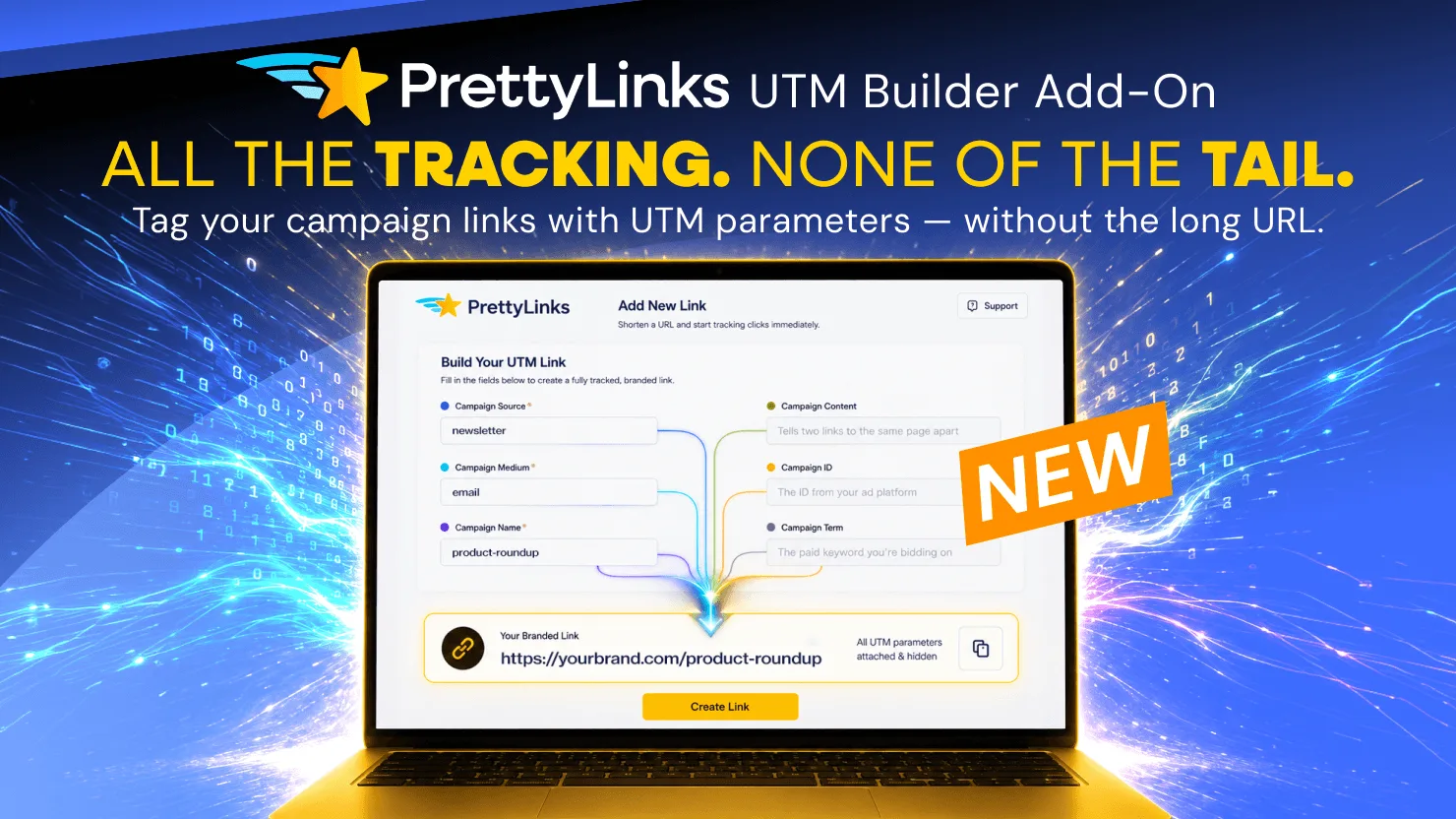
PrettyLinks is the tool for this. You create a clean branded short link for each spot – one for the blog post, one for the discussion thread, one for the resource channel – all pointing to the same affiliate offer.
The dashboard then shows clicks per link, so you can see the member Q&A is outpulling the blog mention three to one. Match that against where the sales land in your affiliate reports, and the guessing is done: you know exactly which community moments make money.
Tracking is what turns a popular conversion into a repeatable one. Once you can see which recommendations convert and where, you stop spreading your effort evenly across every channel and start putting it where it pays – more answers in the thread that converts, fewer links in the spots that never move.
The community creates the conversions. Tracking is how you make them happen again.
Where Your Next Affiliate Link Belongs
The offer was never the problem, and neither was your copy. The same affiliate link converts better inside a community than in front of an audience because the community hands it everything an audience makes it earn from scratch: members who are already invested, peers who vouch for the recommendation, proof playing out in the open, the framing of advice instead of an ad, and a direct line to the people who actually see it. By the time you share the link, most of the convincing has already happened.
So the next time a recommendation underperforms, look at the room before you rewrite the link. A link broadcast to an audience has to win trust, timing, and attention every time, completely cold. That same link inside a community starts with all three already in place.
That’s the real case for building somewhere you own. MemberPress gives you the community where those conditions exist, and PrettyLinks shows you which moments inside it actually convert – so you’re not just dropping links into better rooms; you’re learning which rooms pay and doing more of what works.
You already did the hard part: you built the audience. Give that same audience a place to become a community, and the links you’re already sharing start converting like they finally found the right room to land in.



Leave a Reply