
Targeting lets a single pretty link send different visitors to different destinations based on rules you define — country, device type, browser, operating system, time of day, day of week, and more.
One link, many destinations, automatically chosen for each visitor.
What You Can Target On
- Country — Match one or more countries, or exclude them, so US and European visitors can go to different places;
- Device type — Route mobile visitors to your mobile-optimized page; send desktop visitors to your full site;
- Operating system — iOS visitors to the App Store; Android visitors to Google Play;
- Browser — Send Chrome users one experience, Safari users another;
- Hour of day / day of week — Route to a “store closed” page after hours;
- Date range — Point a destination at a specific date window, then fall back afterward;
- Combinations — Stack multiple conditions with all of: “iPhone users in the US after 9 PM.”
How Rules Are Evaluated
Targeting uses first-match-wins evaluation. Pretty Links checks your rules from top to bottom, and the first one that matches the visitor wins. Their click is redirected to that rule’s destination.
If no rules match, the visitor falls through to the link’s main target URL — that’s your default destination for “everyone else.”
Use the up/down buttons on each rule to reorder them. Put your most specific rules at the top and broader rules below.
Setting Up Targeting
- Edit the link you want to target.
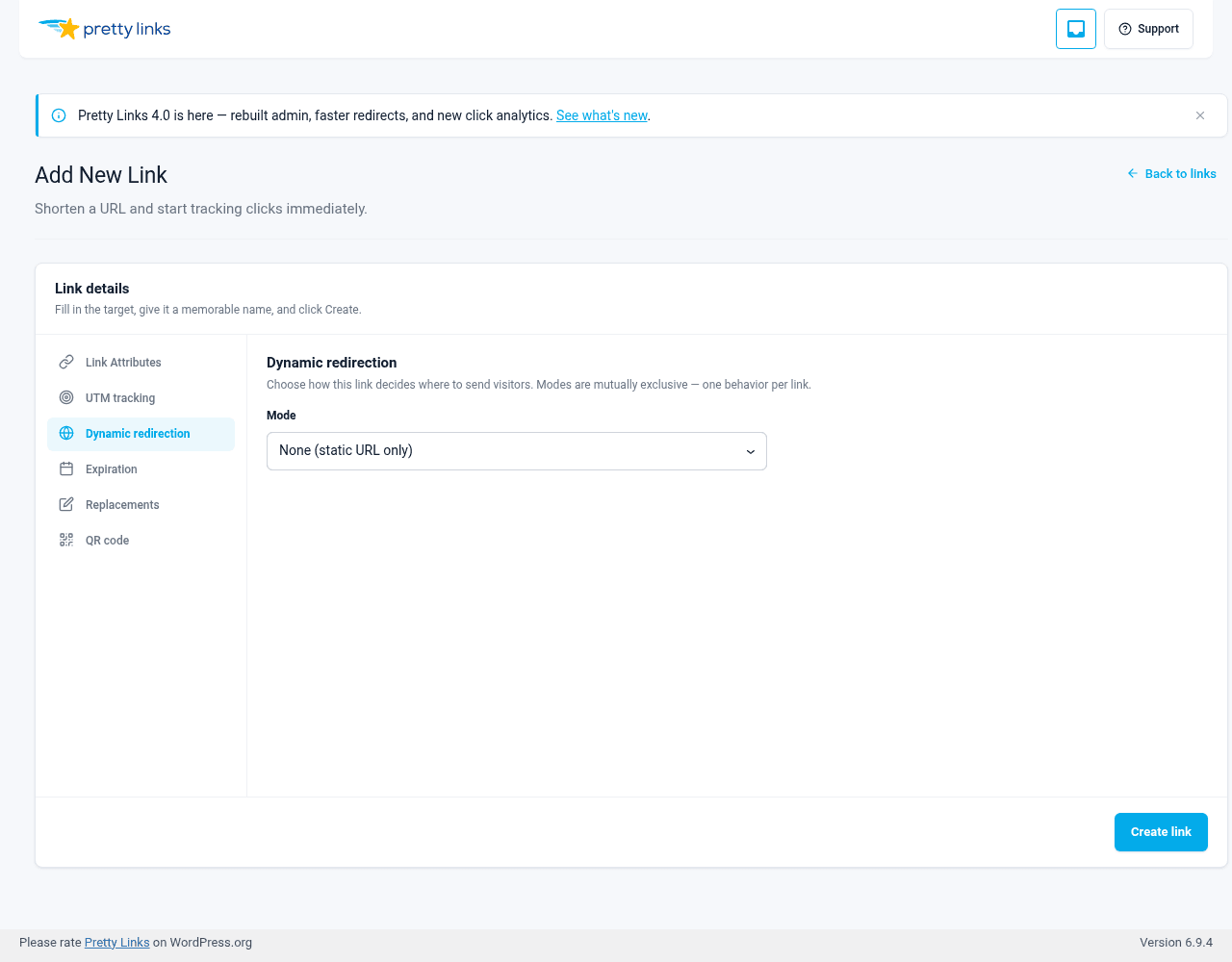
- Open the Dynamic redirection tab.
- Set Mode to Geographic targeting, Device / browser / OS targeting, or Time-based targeting.
- In the Targeting rules panel, click Add rule.
- Choose the operator (e.g. “Country is one of”, “Device type is”, “Hour between”) and a value.
- Enter the Redirect to URL for visitors matching that rule.
- Save the link.
Add as many rules as you need. Reorder rules with the up/down buttons on each row.
Examples
App Store / Play Store Routing
A common pattern for app marketers:
- Rule 1: OS is iOS →
https://apps.apple.com/us/app/yourapp - Rule 2: OS is Android →
https://play.google.com/store/apps/details?id=com.yourapp - Default target URL:
https://yourapp.com/(for desktop visitors)
One short link, three smart destinations.
Geographic Landing Pages
Running a sale with regional pricing or shipping:
- Rule 1: Country is United States →
/sale-us - Rule 2: Country is Canada →
/sale-ca - Rule 3: Country is United Kingdom →
/sale-uk - Default:
/sale-international
Time-Limited Offers
A flash sale that’s only live during certain hours:
- Rule 1: Hour between 9 and 17 (site timezone) →
/flash-sale-live - Default:
/flash-sale-ended
Mobile-First Redirect
Send mobile traffic to a different funnel:
- Rule 1: Device is mobile →
/m/landing-page - Default:
/landing-page
Combining Targeting With Other Redirect Types
Targeting works alongside any redirect type — 301, 302, Cloak Redirect, Pretty Bar, and so on. The redirect type determines how the visitor reaches their destination; targeting determines which destination that is.
For example, you can cloak all your variants under the same pretty URL but route different audiences to different destinations.
Targeting vs. Rotation and Split Tests
Targeting and Rotation are separate Modes on the Dynamic redirection tab, and a link uses only one Mode at a time. Targeting rules and rotation cannot both run on the same link — pick the behavior that fits that link.
- Use Geographic, Device / browser / OS, or Time-based targeting when the destination should depend on who the visitor is or when they click;
- Use Rotation when you want to split traffic across variants for A/B testing or even load distribution.
To combine the ideas, chain two links: a targeting link whose matched destination is itself a rotation link. The first link picks the funnel by rule; the second rotates variants within it.
Tips
- Test each rule. Use a VPN or browser dev-tools device emulator to verify each path works as expected;
- Order matters. Put narrow rules above broad ones. “iOS in the US” should sit above “iOS anywhere.” Time-based rules evaluate in your site’s WordPress timezone, not the visitor’s local time;
- Always set a default target URL. Some visitors will inevitably fall outside all your rules. Make sure they still land somewhere useful;
- Don’t over-segment. Three or four rules is usually plenty. Twenty becomes hard to maintain.