
Keyword replacements automatically turn specific words or phrases in your content into pretty links — site-wide, every time the content is rendered. It’s a direct way to monetize or cross-link existing content without editing posts one by one.
The Basic Idea
You configure a pretty link with one or more keywords. Anywhere those keywords appear in your post and page content, Pretty Links wraps them in a hyperlink to the pretty URL when the page is displayed.
Example: assign the keyword “best web hosting” to your hosting affiliate pretty link. From that moment on, every time you mention “best web hosting” in a blog post, it becomes a clickable link — without you editing any posts.
💡 Not sure which keywords are worth assigning? Our blog post PrettyLinks Replacements Explained walks through five real situations where Keyword Replacement earns its keep, from the product you mention in every roundup to the phrases you use instead of the actual product name.
Setting Up Keywords
- Edit the link you want to attach keywords to.
- Click the Replacements tab and find the Keywords field.
- Type a keyword or phrase and press Enter to add it as a chip. Repeat for each keyword.
- Save the link.
The change takes effect immediately on all your existing content. No re-saving of posts required.
Case Sensitivity
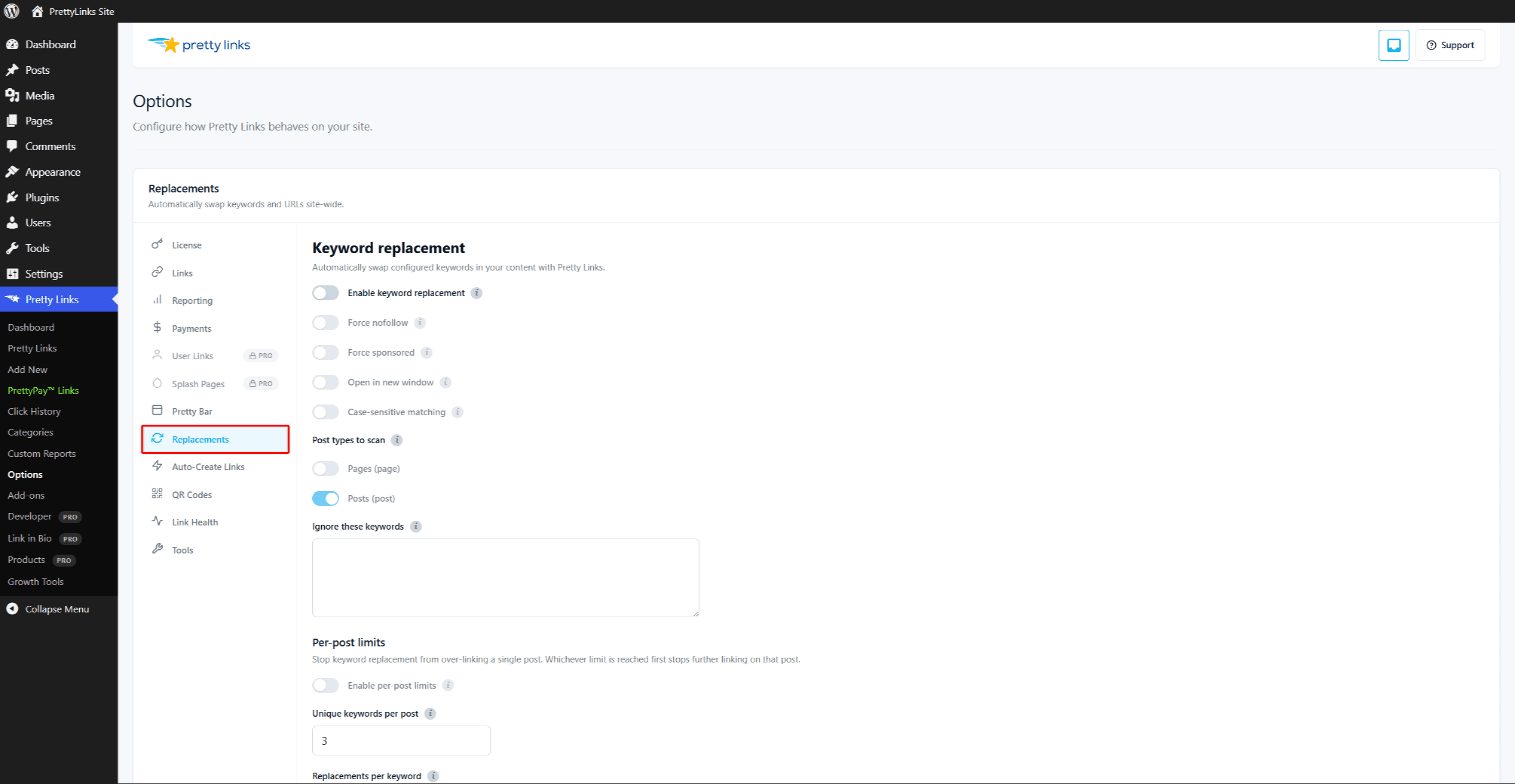
You can choose whether keyword matching is case-sensitive globally at Dashboard > Pretty Links > Options > Replacements. Case sensitivity is off by default, so matching ignores capitalization.
- Case sensitive —
Hostingmatches onlyHosting, nothostingorHOSTING. - Case insensitive (default) — Any combination of upper and lower case matches.
For most sites, the default case-insensitive matching is more useful — it catches mentions wherever they appear in a sentence. Turn on case sensitivity only when casing matters, such as for brand names or technical terms.
Occurrence Limits
Pretty Links can cap how aggressively keywords are linked, so a single article doesn’t fill up with the same link. Turn the caps on with the keyword-thresholds setting under Dashboard > Pretty Links > Options > Replacements.
When the caps are on, the defaults are:
- 3 keywords per post — Pretty Links links at most three distinct keywords in any one post;
- 2 links per keyword — each keyword becomes a link at most twice per post;
- Total links per post: unlimited — no overall ceiling beyond the per-keyword limit.
Each keyword can also carry its own limit, so a high-value affiliate keyword takes a single link while a navigational keyword gets more.
Global Exclusion List
At Dashboard > Pretty Links > Options > Replacements, you can configure a list of pages, post IDs, or URL patterns where keyword replacements should never run. Common candidates:
- Your homepage — Often you want clean, hand-crafted content here;
- Sales pages and landing pages — Where every link placement matters;
- Documentation pages — Where automatic linking can confuse readers;
- Author archives, taxonomy archives — Where excerpts might get over-linked.
You can also disable keyword replacements per-post from the post options metabox.
Force Nofollow and Sponsored
Keyword-replaced links inherit the link’s nofollow and sponsored settings.
If you want to enforce nofollow or sponsored on all keyword-replaced links regardless of the per-link setting, you can flip that in Dashboard > Pretty Links > Options > Replacements. This is a safety net for affiliate-heavy sites: even if you forget to mark a link as sponsored, replacements stay compliant.
Multiple Keywords for One Link
You can assign as many keywords as you want to a single link. Common patterns:
- Product variations —
Aweber, AWeber, aweber emailall point to your AWeber affiliate link; - Topic clusters —
email marketing tools, email service providers, ESPsall point to your roundup post; - Brand misspellings — Catch common typos by listing them as keywords.
Multiple Links Matching the Same Word
If two pretty links both have the keyword “hosting,” only one wins for any given mention. The tiebreaker sorts longer keyword text first, then most recently created — so the last link created with that keyword takes precedence. To avoid surprises, don’t overlap keywords between links. Pretty Links also ships a Duplicate Keywords tool (under Dashboard > Pretty Links > Options > Tools) that surfaces overlapping keywords and lets you pick which link to keep.
Things Keyword Replacement Doesn’t Touch
To prevent breaking your site, keyword replacement skips:
- Existing hyperlinks — Already-linked text isn’t double-linked;
- Headings — H1-H6 elements are left alone;
- Code and pre-formatted blocks — Keywords inside
<code>or<pre>aren’t replaced; - Image alt text and other attributes — Replacements only happen in visible body text;
- Posts you’ve excluded — Via global exclusion or post metabox override.
Performance
Keyword replacement runs every time a post is rendered, but the cost is small even with hundreds of configured keywords. On very high-traffic sites with extensive keyword lists, you might pair Pretty Links with a page-cache plugin so replacements run once and the result is served from cache to subsequent visitors.
Tips
- Start small. Three to five high-value keywords per link is plenty. Don’t try to capture every possible phrasing;
- Set occurrence limits. One replacement per post is usually enough; more rarely helps and often hurts UX;
- Audit the result. Visit a few posts after configuring keywords to see what got replaced. Adjust if anything looks awkward;
- Combine with URL replacements to also catch raw URLs you’ve already typed into posts.