
If you use the Classic Editor (the older TinyMCE-based WordPress editor), Pretty Links integrates with it the same way it does with the block editor — including a one-click button on the editor toolbar.
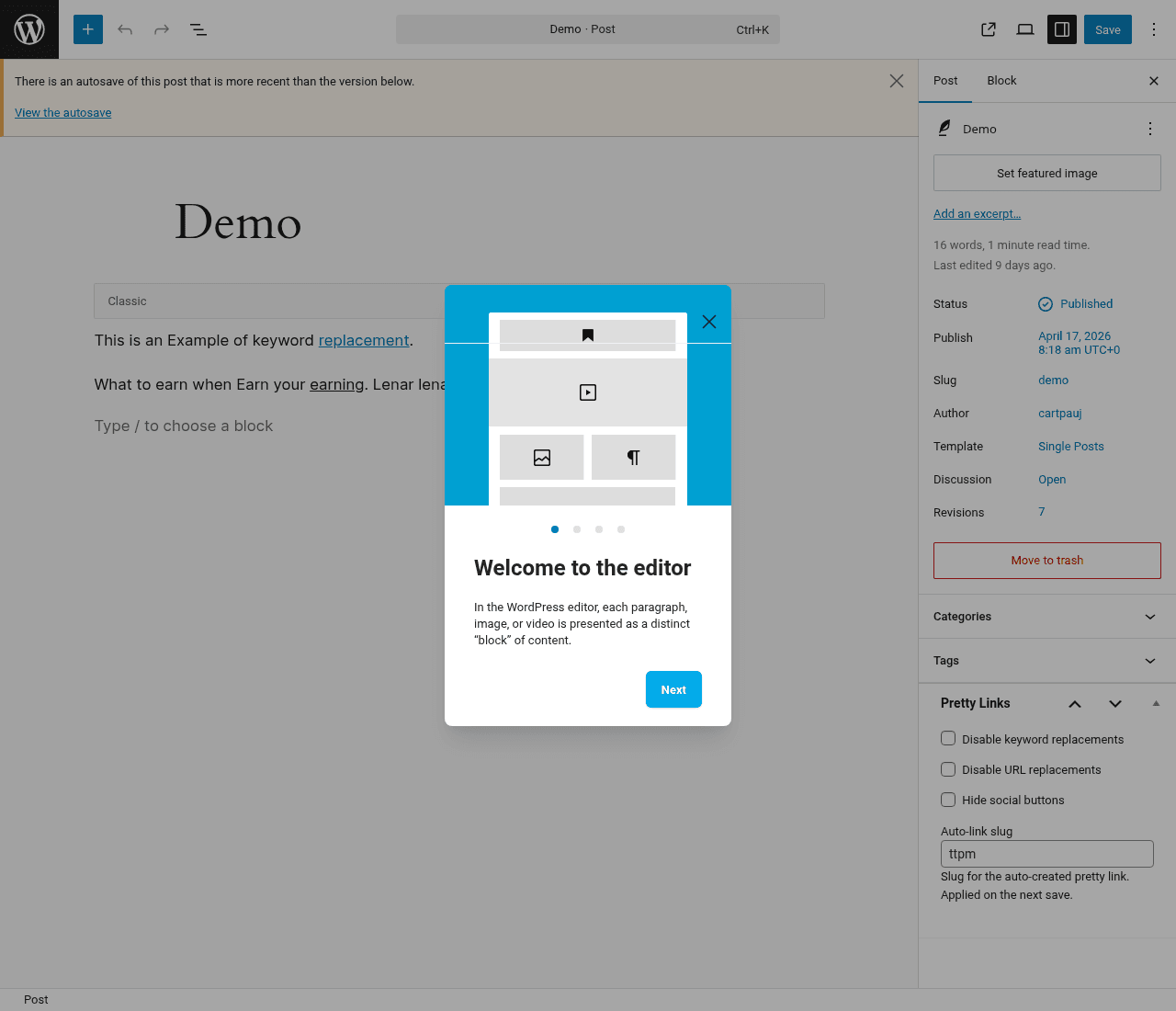
The Pretty Links Toolbar Button
When you have the Classic Editor active (either as your main editor or via the Classic Editor plugin), Pretty Links adds a button to the TinyMCE toolbar.
Click the button to open the search popover. From there you can:
- Search existing links by title, slug, or target URL.
- Pick a link to insert at your cursor position (or wrap your selected text).
- Create a new link inline by entering a target URL — same flow as in the block editor.
The button works in both the Visual tab (the default rich-text view) and the Text tab (raw HTML view). In the Text tab, the inserted markup is plain HTML you can edit by hand if you want.
Inserting a Link
- (Optional) Select the text you want to link.
- Click the Pretty Links button on the toolbar.
- Search and pick a link, or paste a URL and click Create new pretty link.
- The link is inserted at the cursor or around your selection.
If you didn’t select text, the link’s title is used as the visible link text — same behavior as the block editor.
Editing an Inserted Link
To edit a link you’ve already inserted:
- Click anywhere inside the link in the Visual tab.
- The standard TinyMCE link popover appears, showing the URL.
- You can edit, remove, or open the URL from there.
To swap one pretty link for another, remove the current link and use the Pretty Links button to insert a different one.
What’s Stored in the Post
As in the block editor, what gets saved in your post content is the pretty URL — not the target URL. That means:
- Changing the target URL of the pretty link updates every post that uses it, automatically.
- You can swap affiliate offers, fix broken outbound links, or repoint expired URLs site-wide without editing a single post.
This is one of the biggest practical reasons to use Pretty Links inside your content rather than typing target URLs directly into the editor.
Same UX as the Block Editor
The Classic Editor integration intentionally mirrors the block editor experience. You’ll find:
- The same search popover with title/slug/URL matching.
- The same inline create flow for new links.
- The same per-link settings (nofollow, sponsored, etc.) honored when the link is rendered.
- The same support for tracking and advanced redirect types.
If you switch between block and classic editors (some people use both depending on the post type), you don’t have to re-learn anything.
Keyboard Shortcuts
The Classic Editor doesn’t have the same dedicated Ctrl+P shortcut as the block editor, but you can use TinyMCE’s standard accessibility shortcut to focus the toolbar (Alt+F10 on Windows, Option+F10 on Mac), then arrow over to the Pretty Links button and press Enter.
For most workflows, clicking the button is faster.
Compatibility
The Pretty Links button works with:
- WordPress core’s built-in Classic Editor (when activated via the Classic Editor plugin);
- Most page builders that use TinyMCE for text editing inside their widgets;
- The Classic block (the “Classic” block in Gutenberg that wraps TinyMCE), so even if you’re mostly on the block editor, you can use Classic mode for specific blocks.
If you find a context where the button doesn’t appear, check that no other plugin is overriding the TinyMCE toolbar configuration.
Tips
- Use descriptive link titles so search-and-insert is fast;
- Switch to the Text tab if you want to edit the raw HTML around an inserted link (for example, to add a custom CSS class);
- For frequently-used links, consider keyword replacements — automatic linking of specific words or phrases site-wide so you never have to insert manually at all.