
Every new pretty link you create starts with a set of default settings. You configure those defaults at Dashboard > Pretty Links > Options > Links.
Configuring sensible defaults saves time: instead of toggling the same options on every new link, you set them once and let new links inherit them. You can still override on a per-link basis any time.
The Options page autosaves about 600 milliseconds after you stop changing a control — there’s no Save button.
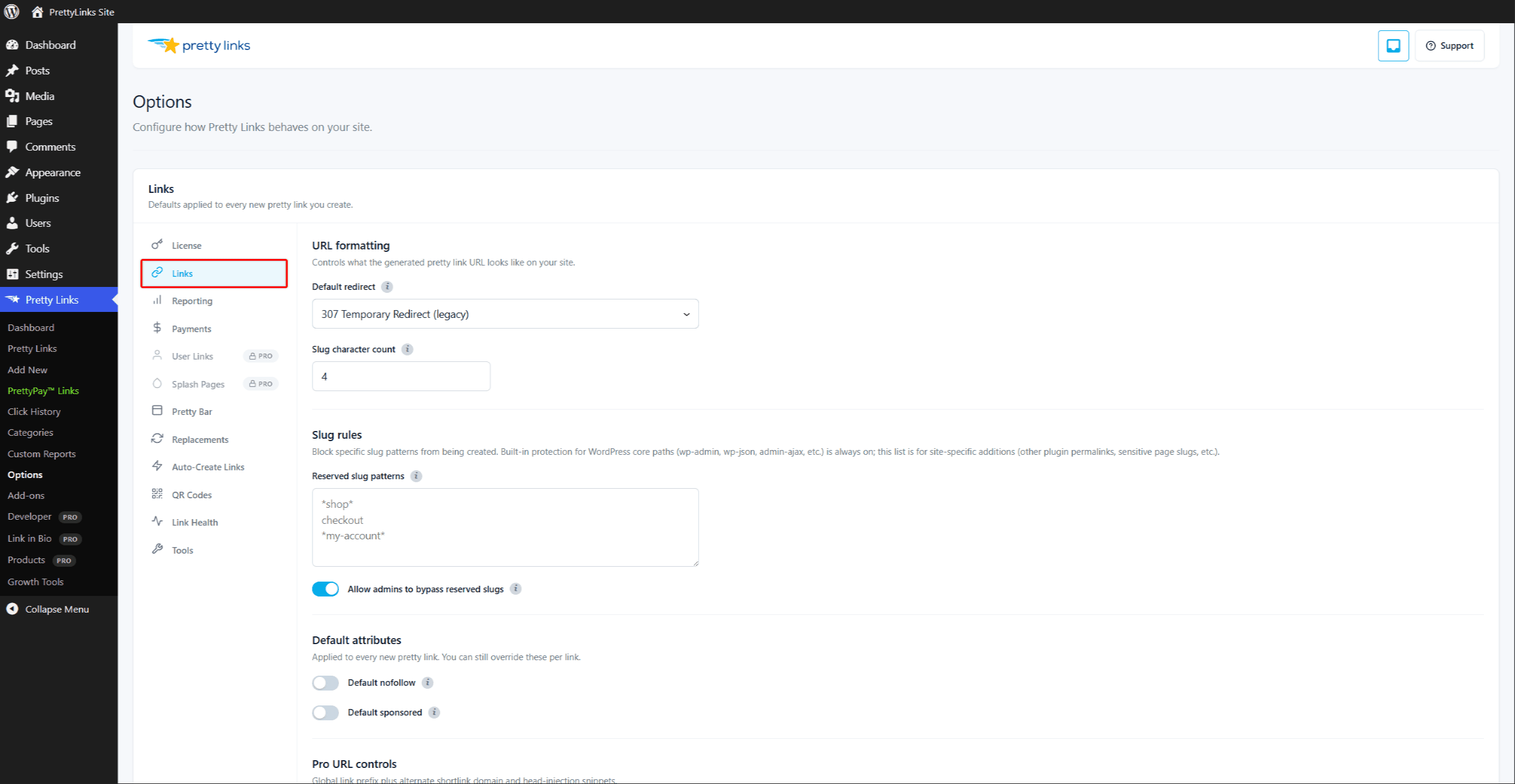
URL Formatting
Default Redirect
Pick the redirect type used for new links:
- 307 Temporary Redirect (legacy) — The shipped default in the current build.
- 302 (Temporary) — Safest choice for most affiliate and campaign links;
- 301 (Permanent) — Best for SEO equity flow, but cached aggressively by browsers.
You can still override this per link on its own edit screen. For more on each, see Redirect Types: 301, 302, and 307.
Recommendation: Stick with 302 unless you have specific SEO reasons to want 301. 302 keeps links flexible — you can change targets without browser-cache headaches.
Slug Character Count
Auto-generated slugs are random short strings. Set how many characters Pretty Links uses when it generates one (minimum 2):
- Shorter (3-4 characters) — More compact, but higher collision risk on busy sites;
- Longer (5-7 characters) — Harder to guess, lower collision risk, slightly less compact.
For most sites, 4-5 characters is the sweet spot. This setting only affects auto-generated slugs — custom slugs you type yourself can be any length.
Slug Rules
Reserved Slug Patterns
A list of slug patterns that Pretty Links will refuse to create. WordPress core paths (wp-admin, wp-json, admin-ajax, etc.) are always blocked automatically; this list is for site-specific additions like other plugin permalinks or sensitive page slugs.
- One pattern per line, or comma-separated;
- Wildcards (
*) are supported —*wp-admin*also blocksmy-wp-admin-thing.
Allow Admins to Bypass Reserved Slugs
When on (the default), administrators can still create links with any slug, including patterns from the list above. Non-admin sources (front-end user dashboards, public-link forms) always have the patterns enforced regardless of this setting.
Turn off if you want the reserved-slug list to apply to admin-created links too.
Default Attributes
These toggles apply to every new pretty link. You can still override them per link.
Default Nofollow
Adds rel="nofollow" to every pretty link rendered into your content, telling search engines not to pass ranking authority to the destination. Recommended for affiliate and outbound links — most affiliate programs and Google’s guidelines expect it.
- Affiliate-heavy sites — Default to on so every new link is nofollowed by default; turn off only for trusted, editorially-vouched-for links;
- General content sites — Default to off; enable per-link for sponsored or affiliate links.
If you’re unsure, default to off and remember to enable per-link for affiliates.
Default Sponsored
Adds rel="sponsored" to every pretty link, declaring to search engines that the link is paid, affiliated, or part of a sponsorship. Google recommends this on top of (or instead of) nofollow for affiliate and ad links.
You can enable both nofollow and sponsored together — many sites do.
Related Global Settings
A couple of behaviors people often expect to find under “default link settings” actually live elsewhere:
- Click tracking on/off — Set under Options > Reporting (“Track clicks on all links by default”). It applies site-wide to every link unless an individual link opts in/out on its own edit screen;
- Open in new window, query-string forwarding, parameter forwarding — Configured per link on the link’s edit screen, not as a global default;
- Pro-only Links extras — When Pretty Links Pro is active, this tab also exposes the link prefix, an alternate shortlink domain, and a global head-scripts field.
How Defaults Are Applied
When you create a new pretty link, the defaults configured here are applied automatically. You can immediately override any of them on the link’s edit screen — defaults are a starting point, not a constraint.
Existing links are not retroactively updated. Changing a default here only affects links created from this point on. To bulk-update existing links, use the bulk operations on the Pretty Links list.
Combining Defaults With the Bookmarklet
The bookmarklet creates pretty links using these same defaults, so the redirect type and rel attributes you pick here flow into every bookmarklet-created link automatically. Worth a few minutes of thought up front — it pays back across every bookmarklet-created, auto-created, public-created, and manually-created link going forward.
Recommended Starter Defaults
For a typical content site that monetizes via affiliate links:
- Default redirect: 302;
- Slug character count: 5;
- Default nofollow: Off (turn on per-link for affiliates);
- Default sponsored: Off (turn on per-link for affiliates).
For an internal-only link manager (no public affiliate work):
- Default redirect: 302 (or 301 if you really want SEO);
- Slug character count: 4;
- Default nofollow / Default sponsored: Off.
Tweak as your needs evolve.