
The Pretty Links post options metabox appears in the sidebar of every post and page editor. It gives you per-post control over how Pretty Links behaves on that specific piece of content — overriding your global settings just for this one post.
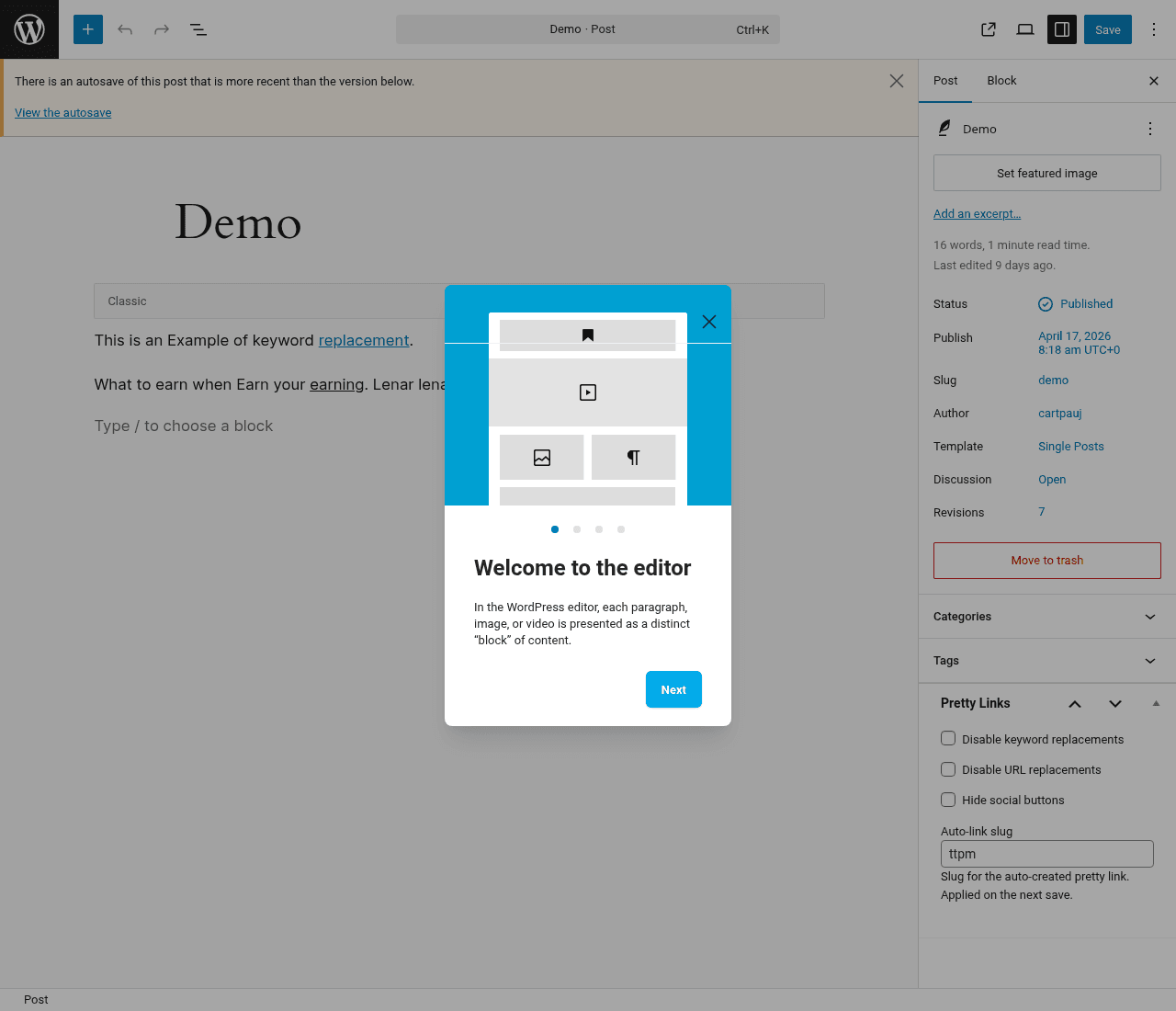
Where to Find It
When editing any post, page, or other supported post type:
- In the block editor, look for the Pretty Links panel in the sidebar (the right-hand column with all the post settings);
- In the classic editor, look for the Pretty Links metabox in the sidebar (you may need to expand it).
The metabox renders on post, page, and any custom post type that has Pretty Links integration configured (auto-create, keyword replacements, or URL replacements enabled for that CPT).
If you don’t see the metabox, your user role may not have the necessary permissions, or the metabox may be disabled for the post type. By default it’s enabled for posts and pages.
What You Can Control
The post options metabox lets you set per-post overrides for several global features:
Pretty Link / Auto-Link Slug
Once auto-create has provisioned a pretty link for this post, the metabox shows the Pretty Link URL at the top so you can copy it.
The Auto-link slug field below it lets you override the auto-generated slug. Type a custom slug (e.g. summer-sale) and save the post — the post’s pretty link will be renamed in place to use that slug. Leave it as-is to keep the suggested slug.
There is no per-post “disable auto-create” toggle. Auto-create only fires on published posts, so drafts and autosaves never trigger it. To exclude a published post from auto-create entirely, you’d need to manually trash its pretty link.
Disable Keyword Replacements
Tick this to skip the keyword replacement feature on this post’s content. Configured keywords elsewhere on the site keep auto-linking; this post gets left alone.
Useful for posts where you’ve manually placed every link and don’t want auto-replacement to add or change anything. Documentation pages, glossaries, and tutorials often benefit from this.
Disable URL Replacements
Tick this to skip the URL replacement feature on this post. URLs you’ve written into the content stay exactly as-typed.
Useful for posts where you specifically want to show the raw destination URL — for example, a post about a particular service that should display the literal https://example.com rather than your branded short link.
Hide Social Buttons
If you’ve enabled social sharing buttons globally, this toggle lets you hide them on a single post.
- Show (default) — The configured social buttons appear on this post;
- Hide — No social buttons render on this post.
Useful for landing pages, thank-you pages, or any post where social sharing doesn’t make sense.
How Overrides Work
Each toggle in the metabox is an override of the corresponding global setting. The defaults are inherited from your global configuration; flipping a toggle here changes the behavior only for this post.
Other posts continue to follow your global settings. There’s no compounding effect — a per-post override doesn’t change the global default.
When to Use Per-Post Overrides
The metabox is meant for exceptions, not routine configuration. If you find yourself toggling the same override on dozens of posts, consider whether you should change the global setting instead. Some signs you’ve crossed that line:
- “I always disable keyword replacements on tutorial posts.” Consider disabling keyword replacements globally and turning them on per-post where you do want them;
- “Every product page hides the social buttons.” Consider per-post-type gating for social buttons;
- “I never want auto-create on private/draft posts.” Auto-create already only fires on publish, not on private/draft posts; if behavior surprises you, check the auto-create config.
Saving Changes
Per-post overrides save when you save the post (Update or Publish in WordPress). They take effect immediately for visitors viewing the post.
Tips
- The metabox honors post types you’ve enabled for Pretty Links integration. If a post type isn’t listed in your auto-create or social-buttons config, the metabox may not show all toggles;
- Override settings travel with the post — if you duplicate the post (with a duplicate plugin), the overrides are duplicated too;
- Use the metabox for genuine exceptions only. Most sites should configure their global settings to match the default behavior they want and use the metabox sparingly.